Got something else on your mind you need help with? Our team of Training Advisors are always on hand to offer support.
Contact Ashfield to speak to our training advisors today.
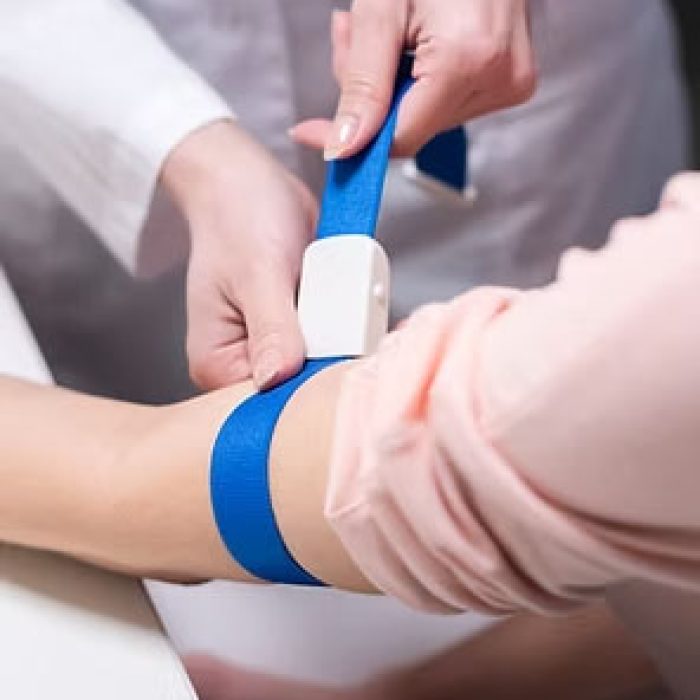
Phlebotomists are people trained to draw blood from a patient (mostly from veins) for clinical or medical testing, transfusions, donations, or research.
Phlebotomists collect blood primarily by performing venepuncture, which is the process of inserting a needle or device into a vein for drawing blood.
In the UK there are no formal requirements or qualifications to become a Phlebotomist. You do not necessarily need to have experience in care or be a Nurse. Many employers within the healthcare setting put their staff through formal training to ensure they can do the skill alongside other elements of their role. It is usually required that you attend a theoretical/ simulation training session. Following this, you will then usually be required to complete a specified number of supervised venepunctures (by a competent person) before you can then do the skill unsupervised.
To enquire about the Venepuncture courses Ashfield Services offer, please call 0800 012 6085.
As mentioned above, there are normal qualifications required. However, this can vary depending on the employer. Before undertaking any training, we would suggest contacting the organisation you are considering and ask about their specific requirements.
A Phlebotomist takes blood and other specimen samples from patients to send to laboratories for diagnostic testing.
Other duties for a Phlebotomist include
Interacting with patients to explain the process
Reassuring patients who feel nervous or uncomfortable
Drawing blood safely and efficiently
Taking into account the patients’ wellbeing whilst drawing blood
Labelling all samples with the patients’ name and date
Transporting samples to laboratories within specified timescales
Adhering to health and safety regulations to ensure samples aren’t contaminated
Once you have completed your training, many organisations employ people to be Phlebotomists. This may be on a permanent, part time or ad hoc basis. Hospitals usually have a Phlebotomy department. However, many other places such as care homes, GP clinics and home care organisations employ Phlebotomists.
We use cookies to improve your experience on our site. By using our site, you consent to cookies.
Manage your cookie preferences below:
Essential cookies enable basic functions and are necessary for the proper function of the website.
Google Tag Manager simplifies the management of marketing tags on your website without code changes.
Statistics cookies collect information anonymously. This information helps us understand how visitors use our website.
Google Analytics is a powerful tool that tracks and analyzes website traffic for informed marketing decisions.
Service URL: policies.google.com (opens in a new window)
You can find more information in our Cookie Policy and Privacy Policy.
